14 October 2026 · Study by Aditya Shrivastava, AI safety researcher
Linear probes on Strands and Kev
Does a guardrail model know more than its answer says? Aditya froze two of them, read the signals inside, and trained a small classifier on those signals with 89 examples. On Strands it fixed most of the model’s mistakes. On Kev, which was already close to perfect, it changed little.
- Strands Decider 2B, balanced accuracy
- 88.3% → 96.9%+8.7 points, 95% interval +6.3 to +11.5
- Kev 4B, balanced accuracy
- 96.5% → 98.4%+1.9 points, interval includes zero
- Held-out test set
- 540 requests8 denied topics, unseen in training and tuning
What this means if you run an open model
You can get a better decision out of an open guardrail model without retraining it. Keep the model frozen, label about 120 requests for your own policy (89 to train the probe, 29 to pick the layer and cutoff), and let a linear probe read one of the model’s middle layers. On Strands that cut missed violations from 42 to 13 and wrongly blocked requests from 20 to 3. Kev was already close to perfect, and the probe made little difference there.
The probe is a weighted sum over one layer’s numbers, which is cheap next to running the model itself. It needs the model’s weights, so it won’t work on a hosted API, and it only knows the policy it was trained on.
Reading the model instead of its answer
A guardrail model reads a request and gives a score: how likely it is that the request breaks the policy. On the way to that score, every layer of the model turns the request into a long list of numbers. A linear probe takes the list from one layer, gives each number a weight, adds them up, and blocks the request if the total passes a cutoff. The model never changes. Only the weights are learned.
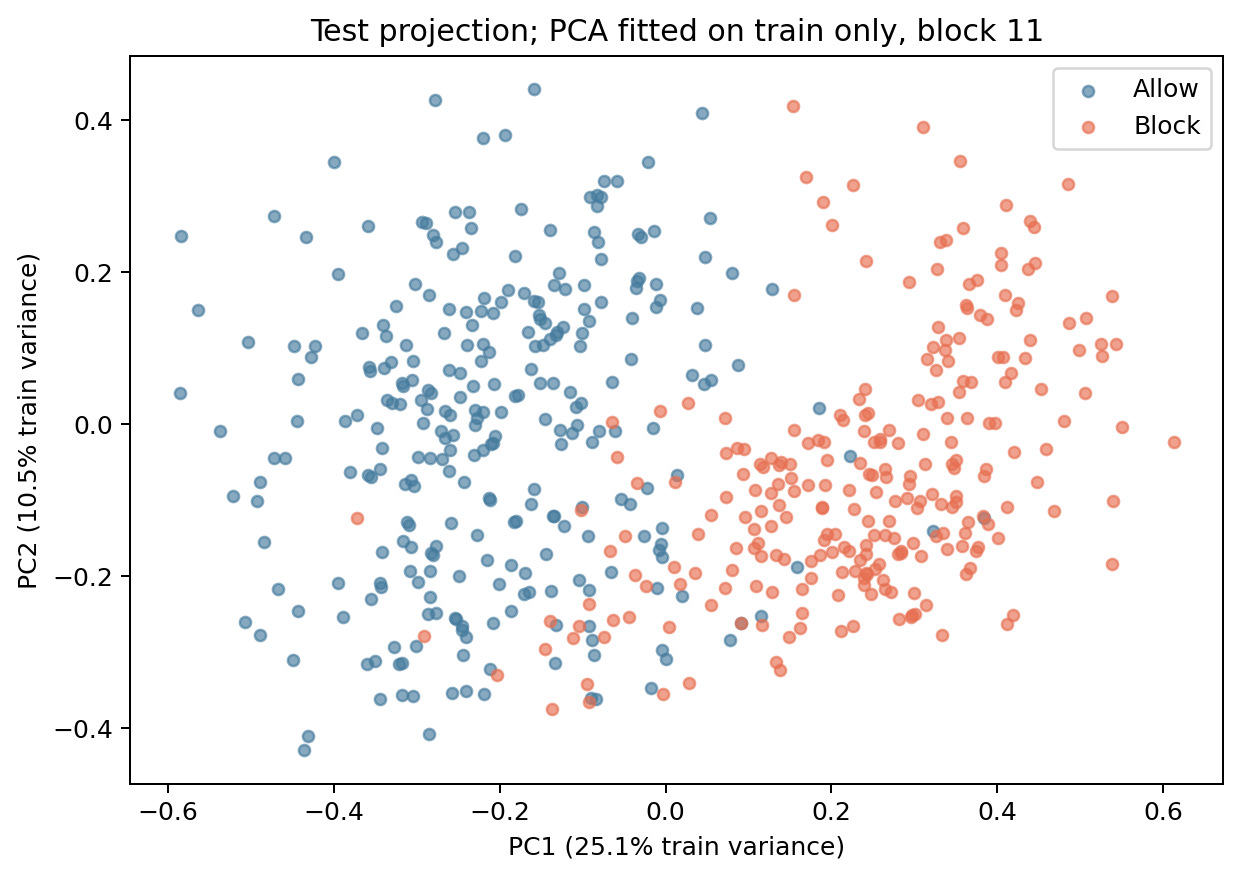
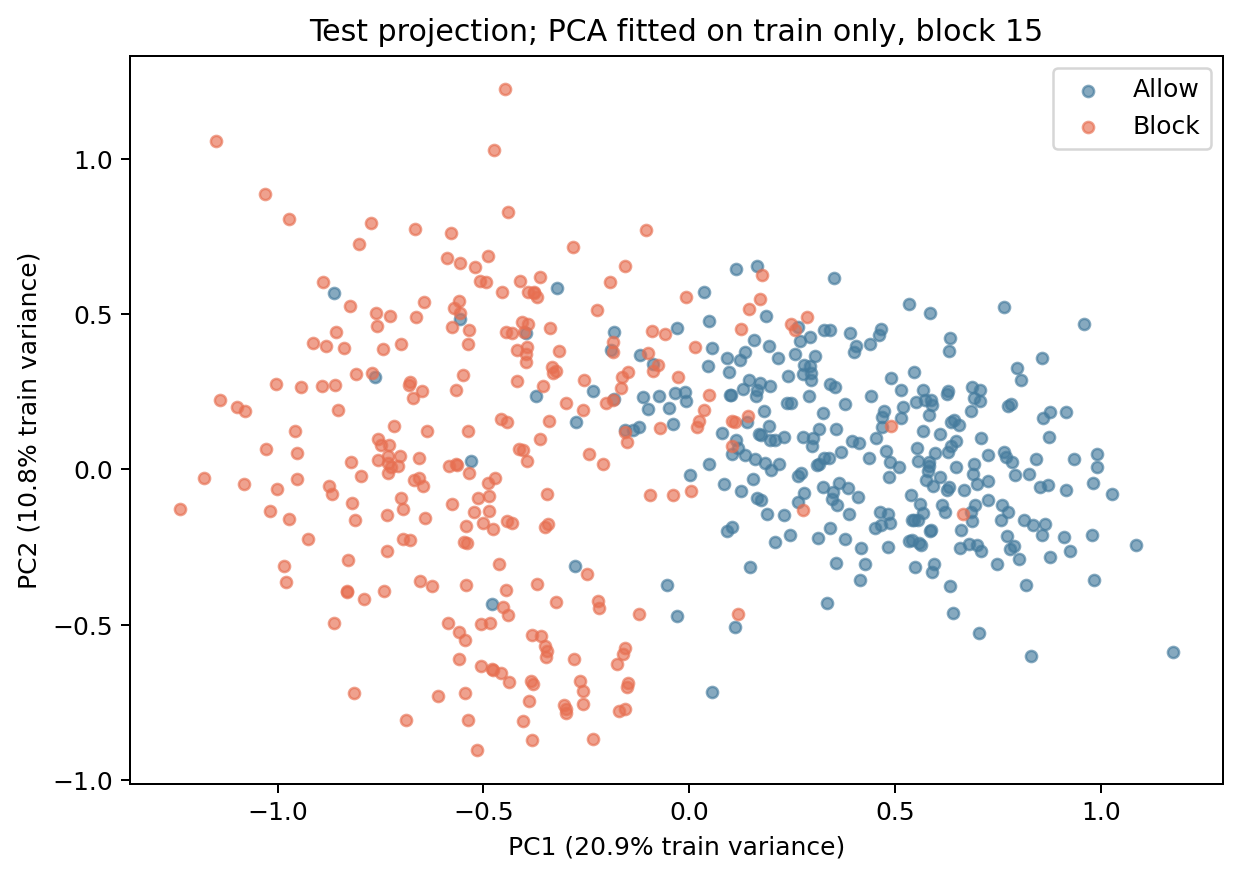
Guillaume Alain and Yoshua Bengio, who introduced probes in 2016, compared them to thermometers placed at different points of a machine that keeps running as usual. (Their paper.) Inside one layer, each request becomes a point in a space with thousands of directions. A linear probe is a single straight cut through that space. Requests on one side get blocked.
Strands Decider 2B, frozen · 24 layers · the probe taps layer 11
- Should be blocked
- Should be allowed
- The probe: everything on the tinted side is blocked
Layer 11 of 24 · the one the study chose
a clean split · AUROC 1.00
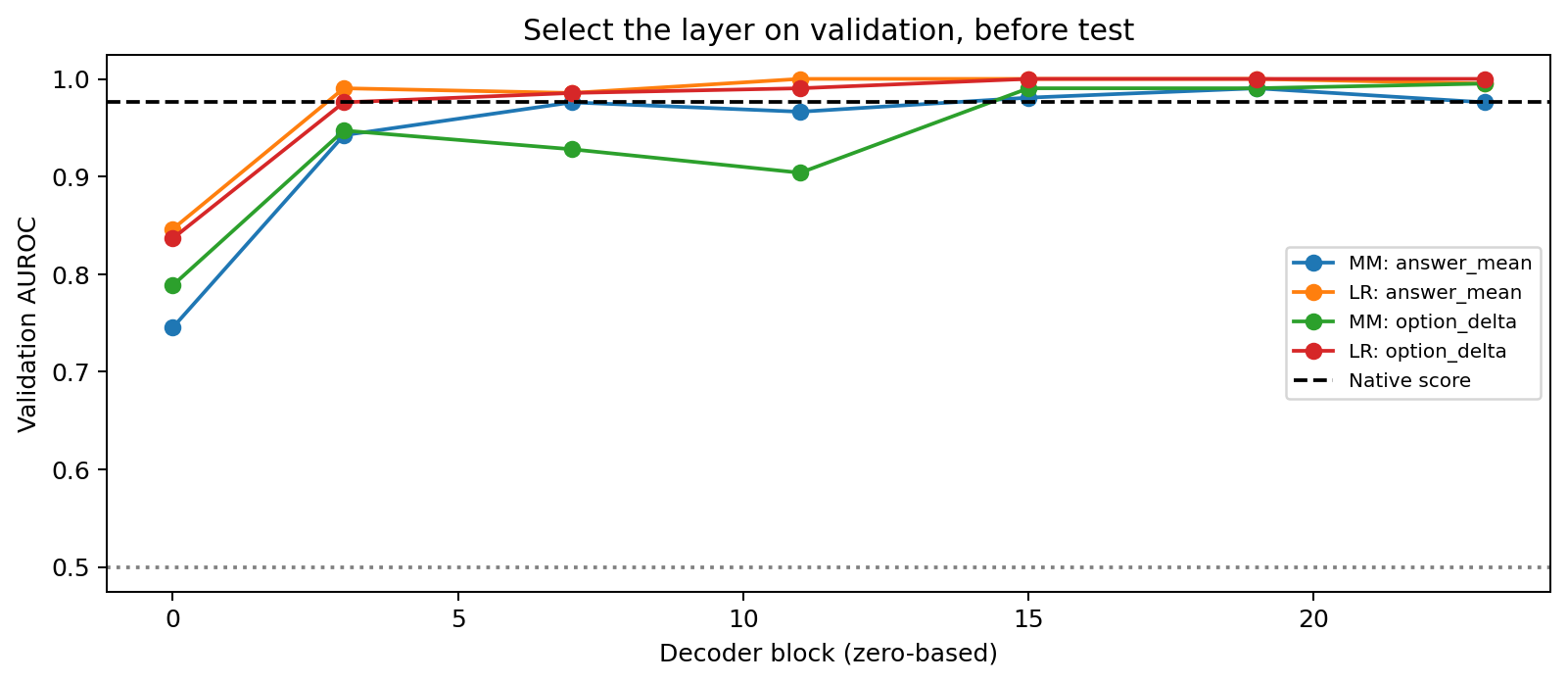
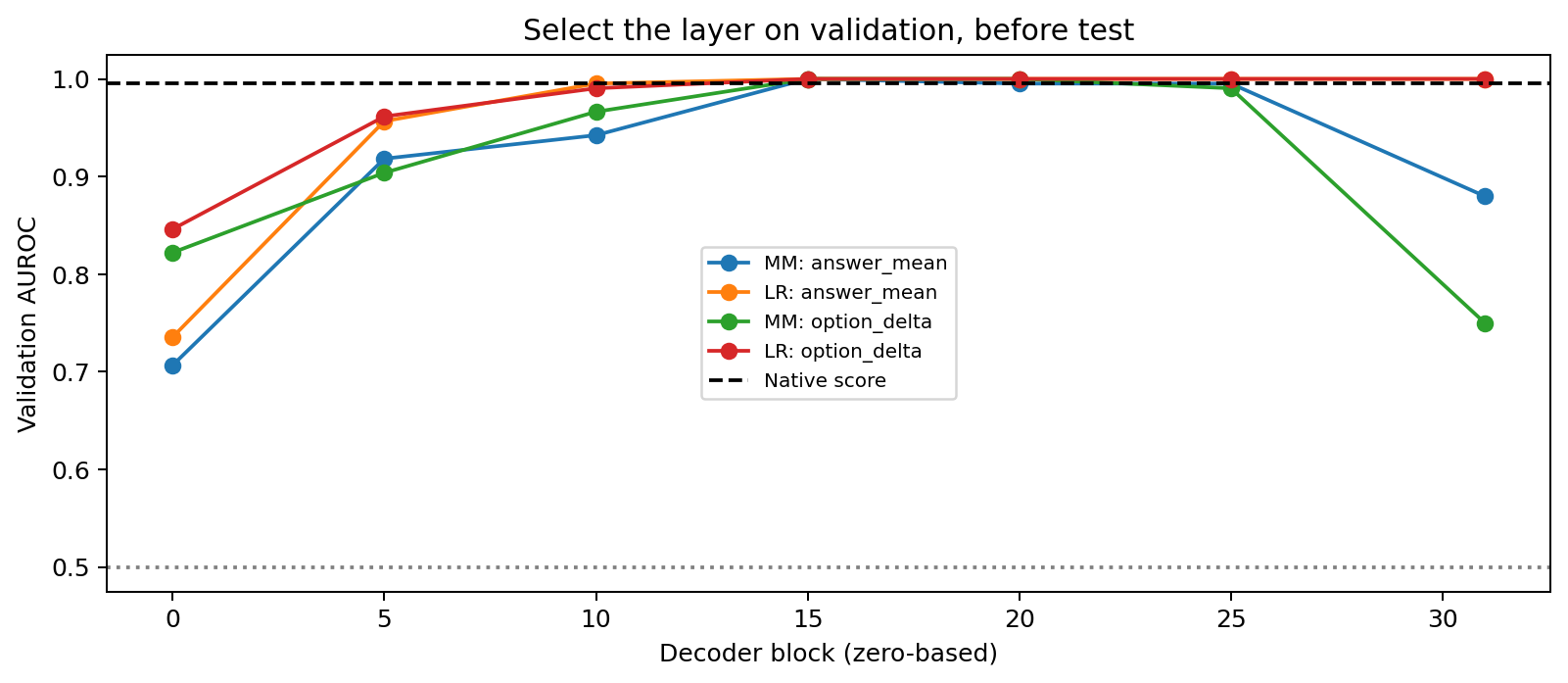
In the first layer, violations and their look-alikes sit mixed together, and no straight cut separates them. Deeper in, they drift apart, and by the middle of the model a probe sorts every validation request correctly. Aditya took the earliest layer that did: 11 for Strands, 15 for Kev. Fig 2 shows every probe type at every sampled layer. Later layers tie with the chosen one, so validation alone can’t pick a winner. That is what the test set is for.
- Linear probe, answer average
- Linear probe, option difference
- Mass-mean probe, answer average
- Mass-mean probe, option difference
Strands Decider 2B · 24 layers
Kev 4B · 32 layers
Validation AUROC (1.0 is a perfect ranking, 0.5 is chance) by layer, counted from zero.
One request, two ways to score it
Take a service that blocks investment advice. Someone asks, “Which stock should I buy?” The right answer is block. Both scorers see the same request inside the same frozen model, and each gets its own cutoff.
One request, two readings
Same request, same frozen model, read in two different places.
Strands Decider 2B, frozen · 24 layers · last layer · layer 11
Built-in score
Reads the model’s answer at the last layer: it asks nine policy questions and keeps the highest score.
Linear probe
Reads layer 11 directly: multiplies each signal by a learned weight and adds them up.
Each path gets its own cutoff, chosen on validation. At or above it means block.
Where the 658 requests went
One dot per request. Related requests stayed in the same split.
Train 89
The probe learns its weights
Choose 29
Pick the layer and both cutoffs
Test 540
Both rules fixed; count mistakes
Each of the eight denied topics, such as investment advice, medical diagnosis and academic dishonesty, has 32 requests to block and 32 look-alikes to allow in the test set. Another 28 requests touch none of the topics. Both cutoffs were fixed on the 29 validation requests before the test set was scored.
Strands made fewer mistakes of both kinds
- Built-in score, tuned cutoff
- Linear probe
- Built-in score, fixed 0.5
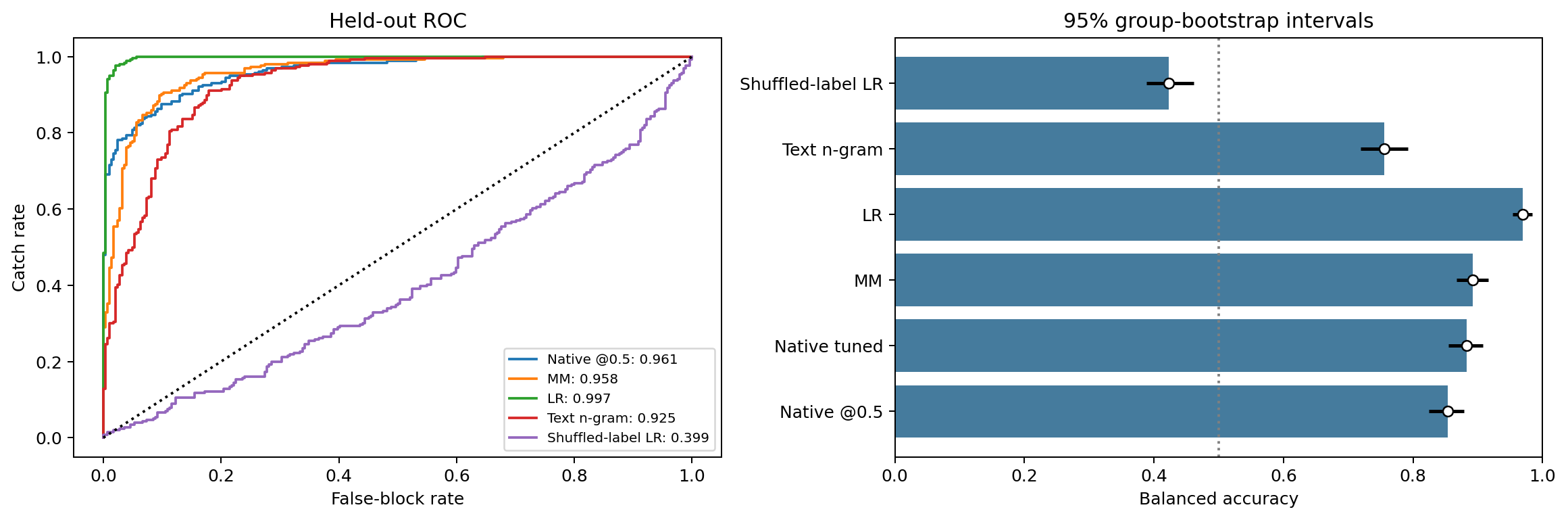
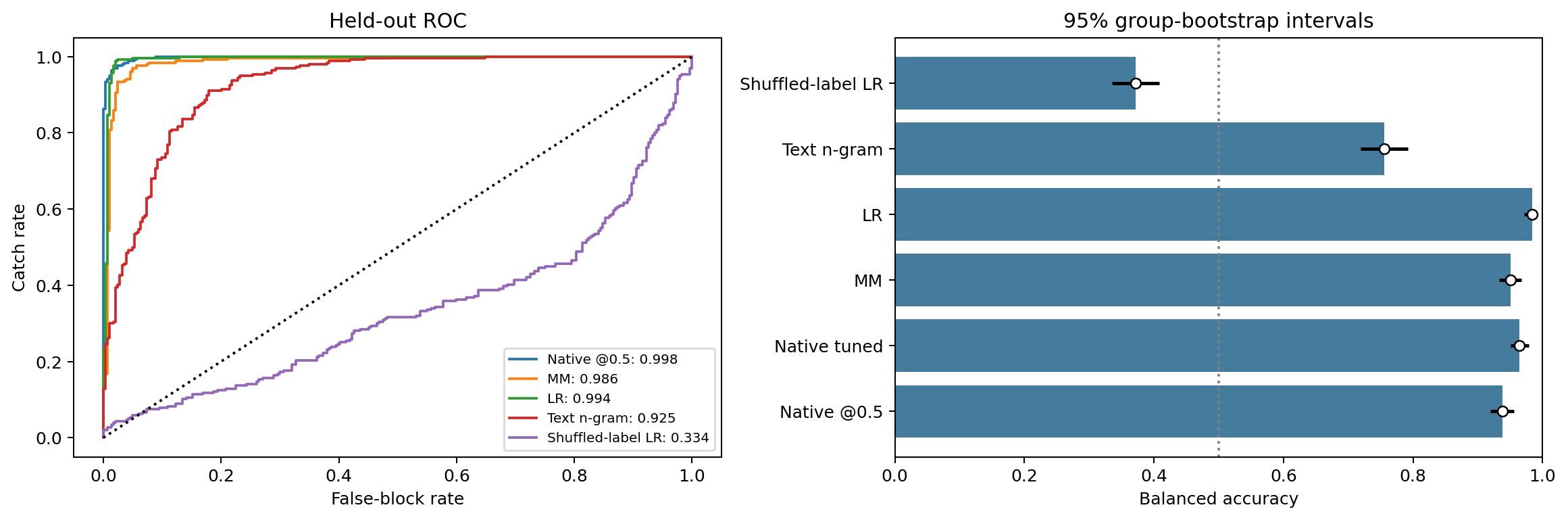
Strands’s own score missed 42 of 256 violations. The probe missed 13. It also blocked 3 safe requests, where the built-in score blocked 20. Improving on both sides at once is the important part. A new cutoff only trades one mistake for the other. The probe found a cleaner signal.
Kev’s own score already caught 255 of 256 violations. Its probe blocked 13 fewer safe requests and missed two more violations. Whether that trade is worth it depends on which mistake costs you more.
Is the gain real?
Two controls rule out the easy explanations. If the probe only picked up the wording of the requests, a classifier that reads the words alone should do as well. It reaches 75.6%. If the probe were memorising noise, training it on shuffled labels should still work. It falls to 42.3%, below chance.
Strands Decider 2B
- Linear probe
- 96.9%
- Built-in, tuned
- 88.3%
Kev 4B
- Linear probe
- 98.4%
- Built-in, tuned
- 96.5%
Percentage points of balanced accuracy
Every test request was scored by both rules, so the comparison is paired. For Strands the gain is +8.7 points, and the whole interval sits above zero. For Kev it is +1.9 points, with an interval that touches zero. A simpler mass-mean probe, which compares the average signal of block and allow examples, did not clearly beat either model’s own score.
What this does not show
All 540 test requests come from the benchmark’s AI-assisted authored set. The other 61 test requests, written by real OpenAssistant users, had no readable text in this release and were left out. The result holds for authored requests. How a probe does on real traffic is still open.
The policy questions stayed the same from training to test, so a probe trained on these eight topics says nothing about a new policy. The score also doesn’t explain why Strands’s answer lost information its middle layers still held.
A probe needs the model’s weights. It works for open models you run yourself, like these two, and can’t be added to a hosted API. The leaderboard scores every system at a fixed 0.5 cutoff and doesn’t include probes.
Check the work
Each notebook ran on one T4 GPU and starts in a short smoke mode. Every number on this page comes from the files below.
Strands Decider 2B
Download notebook ↓ for Strands Decider 2B- Validation by layer for Strands Decider 2BPNG
- Activation map (PCA) for Strands Decider 2BPNG
- Test ROC and accuracy for Strands Decider 2BPNG
- Test metrics for Strands Decider 2BCSV
- Paired comparison for Strands Decider 2BJSON
- Validation search for Strands Decider 2BCSV
- Selected settings for Strands Decider 2BJSON
- Run manifest for Strands Decider 2BJSON